
Cybersecurity governance is how an organization decides who owns cyber risk, how much of it the business will accept, and how leadership checks that the controls are actually working. It sits above day to day security operations: policies, roles, budgets, reporting lines and the metrics the board reviews. Since February 2024, NIST’s Cybersecurity Framework 2.0 has treated it as a function of its own, called Govern.
Threats to cybersecurity are an organizational challenge that is always present, on par with economic, legal, operational and financial threats, and they affect organizations more every year. Managing these risks, and the challenges that come from them, must be part of the organization’s overall risk management portfolio.
Governance is the mechanism through which cybersecurity risk decisions are made. Effective cybersecurity governance gives an organization the right mix of control and influence, and it includes frameworks for both risk reduction and response.
Security governance vs security management
People often use the two terms interchangeably, but they answer different questions.
| Governance | Management | |
|---|---|---|
| Question it answers | Are we doing the right things, and is anyone accountable? | Are we doing those things well? |
| Who owns it | Board, executive leadership, risk committee | CISO, security and IT teams |
| Outputs | Risk appetite, policies, budget, roles, oversight reporting | Controls, tools, monitoring, incident response, patching |
| How often | Quarterly or yearly review, plus major incidents | Daily |
A company can have a capable security team and still fail at governance, for example when nobody senior owns the risk or the board only hears about security after a breach.
Why IT governance is important
IT governance has two main objectives: making sure IT investments produce business value, and reducing the risks that come with IT. Organizations achieve both by setting up a structure with clear accountability for information, business processes, applications and technology.
To make sure the IT function supports the company’s policies and goals, organizations need a structure or system. In general, the larger and more regulated the company, the more precise its IT governance framework needs to be.
5 important IT governance areas are:
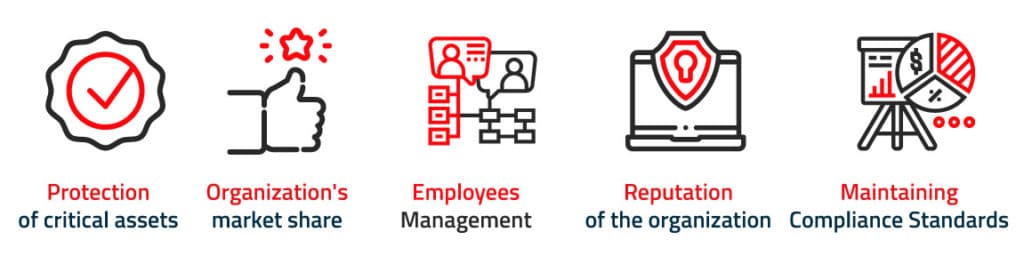
- Protection of critical assets
- Organization’s market share
- Employees Management
- The reputation of the organization
- Maintaining Compliance Standards
What regulators now expect
Governance used to be good practice. In many markets it’s now a disclosure duty.
- NIST CSF 2.0. The framework’s core is now organized around six functions: Identify, Protect, Detect, Respond and Recover, plus the newly added Govern function, as NIST announced with the release of CSF 2.0.
- US public companies. Under rules the SEC adopted in July 2023, a material cybersecurity incident must generally be disclosed on Form 8-K within four business days of the company deciding it is material. Annual reports must also describe the board’s oversight of cyber risk and management’s role in handling it, according to the SEC’s announcement.
- India. CERT-In’s April 2022 directions require listed types of cyber incidents to be reported to CERT-In within 6 hours of noticing them, and ICT system logs to be kept for a rolling period of 180 days.
Each of these assumes someone senior knows the organization’s cyber risk well enough to make a call quickly. That’s a governance question, not a tooling one.
4 action steps for effective governance
When you build cybersecurity governance, make sure it has what it needs to handle the organization’s risks. The structure must name the people and units responsible for cybersecurity and give them the authority to act on that responsibility. These four steps are the essentials.
Monitor indicators
An effective governance framework uses relevant indicators beyond incident counts. That includes preparedness measures such as anti-phishing coverage, cyber risk assessment such as VAPT, and regular employee cybersecurity training such as PhishGrid. Those indicators should feed decisions about strategy and execution.
Establish authority
Make a named executive accountable for cyber risk, and decide who the CISO reports to and how often the board hears from them. Without a clear owner, security decisions default to whoever is shouting loudest after an incident.
Formalize key processes
An effective governance structure formalizes the key processes needed to identify and manage cyber threats, including financial, procurement, technical standards and risk assessment. Incident escalation belongs on that list too, because disclosure deadlines are now measured in hours or days.
Assign roles and responsibilities
Write down who decides, who does the work and who must be informed for each major risk area: identity, vendors, data, cloud, incident response and external threats. Review it whenever the organization changes shape. A cybersecurity policy template is a practical place to start.
Information security governance best practices
- Regulate information security activities on the basis of applicable standards, including legislation, regulations and organizational policies.
- Communicate information security priorities to employees at every level, so the security program is actually implemented.
- Build information security into the enterprise’s other management activities, including strategic planning, capital planning and business architecture.
- Track the performance of the security program continuously, using the resources and information available, with continuous assessment and testing.
- Use what testing and monitoring reveal as an input to management decisions, so the security posture and the organization’s overall performance keep improving.
Metrics the board should actually see
Boards don’t need dashboards full of blocked attacks. A short list that shows whether risk is going up or down works better:
- MFA coverage on email, admin and remote access accounts.
- Time to patch critical, internet facing vulnerabilities.
- Phishing simulation click rate next to the real phishing report rate.
- High risks past their agreed remediation date.
- Time to remove phishing sites, fake apps and impersonating social profiles that target your customers.
The last one is easy to forget because it happens outside the network. Lookalike domains and fake profiles hurt customers and the brand without touching a single internal system. TIKAJ’s takedown service covers that gap, and TIKAJ and its platform Hunto handle more than 100,000 takedowns a year for over 150 enterprise customers.
Cybersecurity governance must stay flexible once it’s in place, so the security program can adapt as new threats call for changes in risk management strategy. An incident response plan that’s tested, not just written, is a good check on whether it has.
FAQ
What is cybersecurity governance?
Cybersecurity governance is the set of structures, roles, policies and oversight processes an organization uses to direct and control its cyber risk. It decides who is accountable, how much risk the business accepts, which framework it follows and what leadership reviews. NIST CSF 2.0 made it a core function, called Govern, in February 2024.
What is the difference between security governance and security management?
Governance sets direction and accountability: risk appetite, policies, budgets and board oversight. Management carries that direction out through controls, tools, monitoring, patching and incident response. Governance is owned by the board and executives, while management is owned by the CISO and security teams. Both are needed, and weak governance often shows up as unclear ownership.
What frameworks are used for cybersecurity governance?
The most widely used are the NIST Cybersecurity Framework 2.0, which now has a dedicated Govern function, ISO/IEC 27001 for information security management systems, and COBIT for broader IT governance. Regulated sectors add their own rules, such as SEC disclosure requirements for US listed companies and CERT-In directions in India.
Who is responsible for cybersecurity governance?
The board holds ultimate oversight, and a named executive, often the CEO, CRO or CIO, is accountable for cyber risk. The CISO advises leadership, runs the security program and reports on it. Business owners stay responsible for risks in their own areas, such as vendors, customer data and the applications they run.